

Introduction
Hyper casual games are known for their simple gameplay, quick sessions, and easy-to-understand mechanics. But creating a game is only one part of the process.
For developers, the bigger challenge is turning players and engagement into sustainable income.
Understanding hyper casual game revenue can help indie developers make better decisions about advertising, retention, monetization, and user acquisition.
No fixed amount determines what every hyper casual game earns. A game with 1 million downloads may generate very different revenue from another game with the same number of downloads.

Factors such as daily active users, player retention, session length, ad impressions, eCPM, audience location, and monetization strategy all influence earnings.
In this guide, you will learn how to increase hyper-casual game revenue, how hyper-casual games make money, how advertising affects earnings, what happens at 1 million downloads, and which monetization strategies developers can use to build a more sustainable mobile game business.
What Is Hyper Casual Game Revenue?
Hyper casual game revenue is the money a simple mobile game generates through advertising, in-app purchases, paid features, subscriptions (where applicable), or other monetization methods.
Unlike premium games that may depend heavily on an upfront purchase, hyper casual games are commonly distributed for free.
This allows developers to attract a large number of players and monetize their engagement.
The basic hyper casual game revenue model can be represented as:
Players → Gameplay → Engagement → Monetization → Revenue
For example, a player downloads a free game, plays several sessions every day, sees advertisements between or during gameplay, and may optionally purchase an ad-removal feature. Each of these interactions can contribute to the game's overall revenue.
However, downloads alone do not determine income. A developer needs active players who continue playing and generate meaningful monetization opportunities.

How Do Hyper Casual Games Make Money?
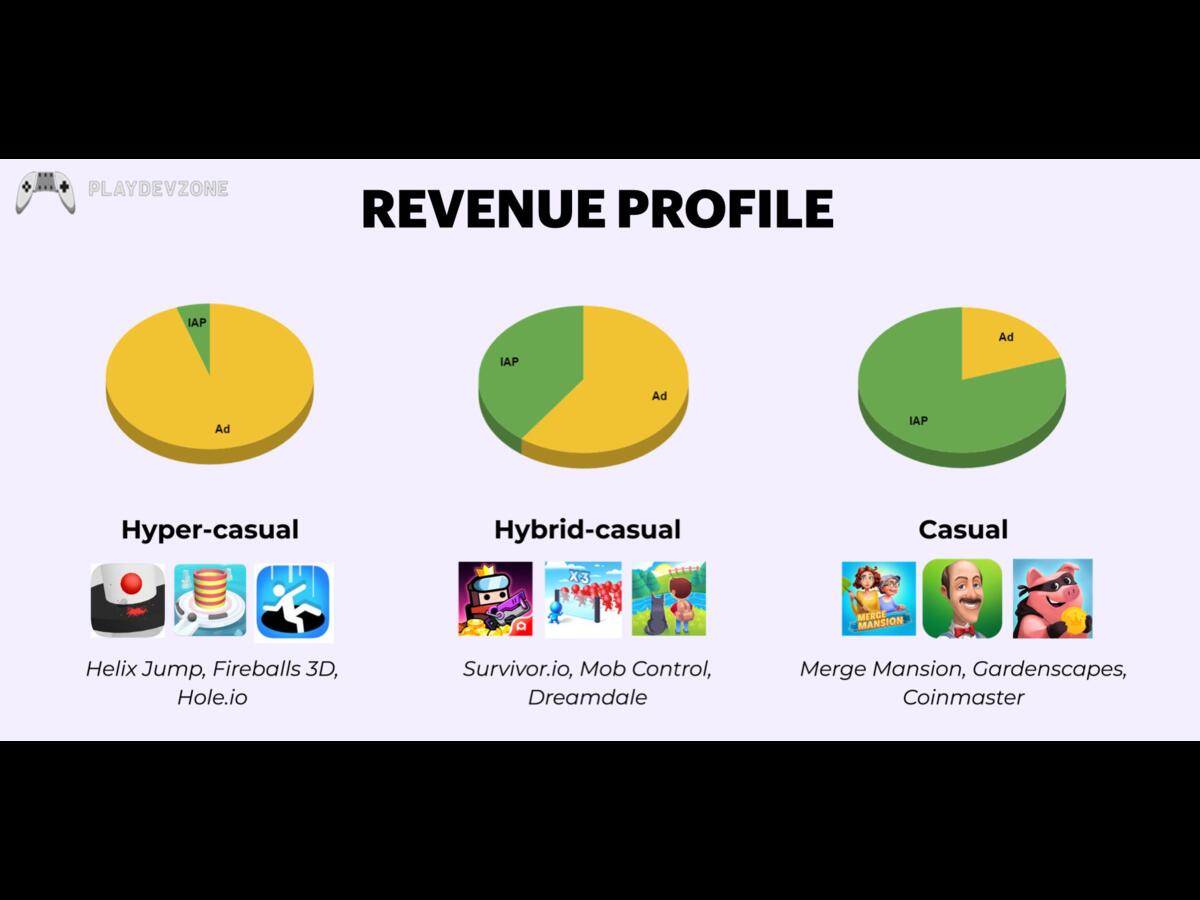
There are several ways hyper-casual games make money, but advertising is often an important component because these games are frequently free to download.
The most common methods include:
- Interstitial advertisements
- Rewarded video advertisements
- Banner advertisements
- In-app purchases
- Remove-ads purchases
- Cross-promotion
- Other mobile advertising formats
A developer can combine several methods rather than relying entirely on one source.
For example, a game might use interstitial ads between appropriate gameplay moments, rewarded ads for optional bonuses, and an in-app purchase that removes advertising.
The goal is not simply to show as many ads as possible. Excessive advertising can frustrate players, reduce retention, and ultimately reduce the number of people available to monetize.

Main Sources of Hyper Casual Game Revenue
Understanding each monetization channel is important when developing a hyper-casual game revenue strategy.
Interstitial Ads
Interstitial ads are full-screen ads shown at appropriate pauses in gameplay, such as when a player completes a level, finishes a round, or moves to another stage.
For example, an interstitial might appear after a player finishes a level or completes a run.
When implemented carefully, interstitial advertising can provide a significant source of hyper-casual game ad revenue.
However, developers should avoid advertising immediately after every small interaction. Poor timing can interrupt gameplay and increase player churn.
Rewarded Video Ads
Rewarded ads give players the option to watch a short advertisement voluntarily in return for valuable in-game rewards, such as extra lives, bonus coins, or other useful items.
Possible rewards include:
- Extra lives
- Additional coins
- Revives
- Bonus points
- Unlocking temporary features
- Additional attempts
Rewarded ads can be particularly useful because players choose to engage with the advertisement when they want the reward.
A well-designed rewarded ad system can contribute to hyper casual game revenue while giving players something valuable in return.
Banner Ads
Banner ads are compact advertisements placed within the game interface, allowing developers to generate advertising revenue while keeping the main gameplay experience largely uninterrupted.
They can remain visible while a player is using certain screens or menus.
However, banner ads generally need careful placement because they can interfere with the game's user interface or reduce the visual quality of the experience.
For some games, banners can provide additional advertising income without interrupting gameplay.
In-App Purchases
Although hyper casual games traditionally focus heavily on advertising, in-app purchases can also contribute to hyper casual mobile game monetization.
Possible purchases include:
- Remove ads
- Cosmetic items
- Extra lives
- Special effects
- Premium features
- Additional content
Not every player will make a purchase, so IAP should usually complement rather than completely replace advertising in a free hyper casual game.
Remove-Ads Purchases
A simple remove-ads option can be useful for players who enjoy the game but do not want to see advertisements.
For example, a developer might offer a one-time purchase that removes certain advertisements from the game.
This can create another source of hyper-casual game revenue while improving the experience for paying users.
Hyper Casual Game Revenue From Ads
Advertising is one of the most important areas developers need to understand when analyzing hyper-casual game revenue from ads.
Advertising earnings can depend on several variables, including:
- Number of active users
- Number of ad impressions
- Ad format
- eCPM
- Fill rate
- Player location
- Session frequency
- Retention
- Engagement
- Ad network demand
One common metric is eCPM, which represents estimated earnings per 1,000 ad impressions.
A simplified example is:
Estimated ad revenue = Ad impressions ÷ 1,000 × eCPM
Suppose a hypothetical game generates 100,000 ad impressions and the effective eCPM is $5.
The calculation would be:
100,000 ÷ 1,000 × $5 = $500
This is only a hypothetical example. Actual earnings can be significantly different depending on the advertising market, platform, country, ad format, fill rate, and other factors.
Therefore, developers should use their own analytics data when estimating hyper-casual game revenue.
How Much Revenue Do Hyper Casual Games Make?
There is no universal answer to the question how much revenue do hyper casual games make.
Two games with identical download numbers can have completely different earnings.
Consider two hypothetical games:
Metric
Downloads
Monthly active users
Average sessions
Ad impressions
Retention
Revenue Potentially
Game A
1,000,000
200,000
Higher
Higher
Better
higher
Game B
1,000,000
60,000
Lower
Lower
Lower
Potentially lower
This example demonstrates why downloads should not be treated as a direct revenue calculator.
A game can receive millions of downloads but generate relatively limited income if players stop playing quickly.
Another game with fewer downloads could generate stronger monetization if its players return frequently and produce more valuable ad impressions.
How Much Revenue Can a Hyper Casual Game Make Per 1 Million Downloads?
The question of hyper-casual game revenue per 1 million downloads is common among developers.
However, there is no fixed revenue amount associated with 1 million downloads.
Imagine a hypothetical game receives 1 million downloads. Only a portion of those users may remain active after installation. Some users may uninstall immediately, while others may continue playing for weeks or months.
For example, assume a hypothetical scenario produces:
- 1,000,000 total downloads
- 150,000 monthly active users
- 3 million monthly ad impressions
- $4 hypothetical average eCPM
Estimated advertising revenue would be:
3,000,000 ÷ 1,000 × $4 = $12,000
Again, this is not a guaranteed earnings figure. It is simply an example showing how ad impressions and eCPM can be used to understand a potential revenue calculation.
If another game receives the same 1 million downloads but produces only 500,000 ad impressions per month, its advertising income could be dramatically different.
This is why developers should analyze active users and monetizable engagement instead of focusing only on lifetime downloads.
What Factors Affect Hyper Casual Game Revenue?
Several factors can influence hyper-casual game revenue.
1. Downloads
Downloads are important because they determine the potential size of the player base.
However, downloads are only the starting point.
2. Daily Active Users
DAU measures how many users actively play the game on a typical day.
A larger active audience can create more opportunities for advertising and purchases.
3. Player Retention
Retention measures how many users continue playing after installation.
If players uninstall the game quickly, there are fewer opportunities to generate future revenue.
Improving retention is therefore one of the most important parts of hyper-casual game revenue optimization.
4. Session Length
Longer sessions can potentially create more opportunities for players to interact with monetization features.
However, developers should focus on enjoyable gameplay rather than artificially increasing session length.
5. Ad Impressions
More legitimate ad impressions can increase advertising income, but excessive advertisements can damage the player experience.
The objective should be better monetization efficiency, not simply more advertisements.
6. eCPM
eCPM can vary depending on:
- Country
- Platform
- Ad format
- Season
- Advertiser demand
- Audience quality
Consequently, the same number of impressions can produce different amounts of hyper casual game revenue.
7. Player Geography
Advertising markets differ between countries.
A game's audience distribution can therefore influence advertising performance.
Developers should examine their own analytics rather than assuming that every country will produce the same advertising value.
8. Engagement
Players who frequently return to a game can create more opportunities for advertising and purchases.
Strong engagement can therefore contribute to sustainable hyper-casual game revenue.
How To Increase Hyper Casual Game Revenue
If you want to know how to increase hyper-casual game revenue, start by improving the entire player journey rather than simply adding more advertisements.
Improve Player Retention
Retention is essential.
Ask yourself:
- Is the first gameplay experience clear?
- Is the game fun within the first few seconds?
- Does difficulty increase gradually?
- Are controls responsive?
- Does the player have a reason to return?
A game that keeps players engaged for longer can create more sustainable monetization opportunities.
Improve Ad Placement
Ad placement should feel natural.
Good opportunities may include:
- After completing a level
- After a failed attempt
- Between gameplay rounds
- On optional reward screens
Avoid placing advertisements at moments when they interfere with important controls or frustratingly interrupt gameplay.
Better placement can improve hyper casual game revenue without requiring an aggressive advertising strategy.
Use Rewarded Ads Strategically
Rewarded ads should provide something players genuinely want.
For example, if a player loses a difficult run, offering an optional revive can make sense.
The reward should be clear before the player decides whether to watch the advertisement.
Increase Session Quality
Instead of forcing users to play longer, improve the quality of gameplay.
Consider:
- Faster loading
- Responsive controls
- Short but satisfying levels
- Meaningful progression
- Daily challenges
- Unlockable cosmetics
- Simple achievement systems
Better gameplay can improve retention and indirectly support hyper-casual game revenue.

A/B Test Monetization
A/B testing allows developers to compare different versions of their monetization system.
For example, you might test:
Version A: Interstitial after every three rounds.
Version B: Interstitial after every five rounds.
Then compare metrics such as:
- Retention
- Session length
- Ad impressions
- Revenue per user
- Churn
The objective is to identify a configuration that balances monetization and player experience.
Optimize User Acquisition
Generating revenue is only one side of mobile game economics.
If you spend $10,000 acquiring users and generate $5,000 from those users, increasing downloads alone does not solve the problem.
Developers should monitor acquisition costs alongside hyper-casual game revenue.
Useful metrics include:
- Cost per install
- Revenue per user
- Retention
- Lifetime value
- Return on advertising spend
- Revenue vs Profit: What Developers Need To Know
Revenue is not the same as profit.
For example:
Revenue = $10,000
But suppose the developer spends:
- $2,000 on development services
- $3,000 on user acquisition
- $500 on software and services
- $500 on other expenses
The simplified remaining amount would be:
$10,000 − $6,000 = $4,000
That does not necessarily represent final profit because other taxes, platform fees, business costs, and applicable expenses may still need to be considered.
Therefore, when analyzing hyper-casual game revenue, developers should always consider both income and expenses.

A Practical Hyper Casual Monetization Strategy for Beginners
If you are a beginner, avoid making your monetization system unnecessarily complicated.
A practical approach could look like this:
Step 1: Build a Small Playable Prototype
Create the basic gameplay loop first.
The game should be enjoyable before you add monetization.
Step 2: Test With Real Players
Observe where players quit, where they struggle, and which parts they enjoy.
Step 3: Add Limited Interstitial Ads
Place ads at natural breaks rather than constantly interrupting gameplay.
Step 4: Add Rewarded Ads
Give players optional rewards that have real gameplay value.
Step 5: Track Analytics
Monitor:
- DAU
- Retention
- Sessions
- Session length
- Ad impressions
- eCPM
- Revenue per user
- Churn
Step 6: Test Different Configurations
Use controlled tests to compare different ad frequencies and reward systems.
Step 7: Improve Retention
Fix gameplay problems before trying to maximize advertising exposure.
Step 8: Scale Carefully
Once the game demonstrates healthy engagement and monetization, consider expanding user acquisition.
This approach can create a more sustainable hyper-casual game revenue model.
Frequently Asked Questions
How do hyper casual games make money?
Many use advertising, including interstitial, rewarded, and banner ads. Some also use in-app purchases and remove-ads purchases.
How much can a hyper-casual game make from 1 million downloads?
There is no standard amount. One million downloads can produce very different results depending on how many users remain active and how frequently they generate monetizable engagement.
How much revenue do hyper casual games make?
There is no fixed amount. Earnings depend on downloads, active users, retention, ad impressions, eCPM, audience geography, engagement, and monetization methods.
Is advertising important for hyper casual games?
Advertising can be an important monetization channel because many hyper-casual games are free to download.
However, ad frequency and placement should be balanced with the user experience.
What is the best way to increase hyper casual game revenue?
Focus on retention, engagement, appropriate ad placement, rewarded ads, testing, user acquisition efficiency, and understanding your audience rather than simply increasing ad frequency.
Do rewarded ads increase revenue?
They can create additional monetization opportunities when players voluntarily watch advertisements for useful rewards.
Actual results depend on player behavior and implementation.
Conclusion
Increasing hyper-casual game revenue is not simply about displaying more advertisements or getting more downloads.
Sustainable monetization comes from creating a game that players actually want to continue playing.
Developers should focus on the complete relationship between gameplay, retention, engagement, advertising, purchases, and costs.
Interstitial ads, rewarded videos, banners, and remove-ads purchases can all play a role, but each should be implemented according to the game's design and audience.
A game's actual performance depends on active users, retention, session behavior, ad impressions, eCPM, geography, monetization implementation, and expenses.
By continuously analyzing these metrics, testing different approaches, improving the player experience, and controlling acquisition costs, developers can build a more informed and sustainable approach to hyper casual game revenue.